
What Does a Digital Marketing Agency Do? (And Do You Need One?)
Learn what digital marketing agencies actually do—from SEO and AIO to paid ads and content—and how to decide if hiring one is right for your business.
AI & RISK
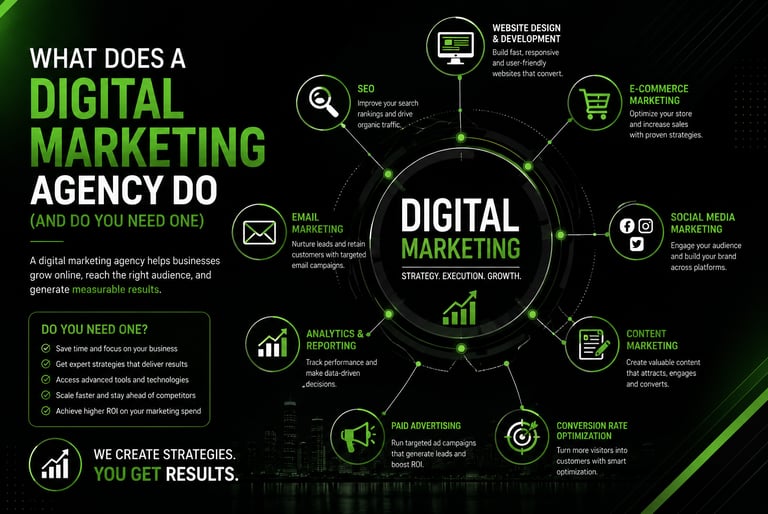
What Does a Digital Marketing Agency Do (And Do You Need One)?
If you've ever stared at your business's website analytics and wondered why traffic isn't converting into customers, or if you've typed a question into ChatGPT and noticed your competitor's brand shoIf you've ever stared at your business's website analytics and wondered why traffic isn't converting into customers, or if you've typed a question into ChatGPT and noticed your competitor's brand showing up in the answer while yours is nowhere to be found, you've already brushed up against the two forces reshaping how businesses get discovered online: Search Engine Optimization (SEO) and the newer discipline of AI Optimization (AIO), sometimes called Answer Engine Optimization or Generative Engine Optimization (GEO).
Digital marketing agencies exist to help businesses navigate exactly this kind of complexity. But "digital marketing agency" is a broad label that covers everything from a two-person freelance outfit running Instagram ads to a 200-person firm managing global brand campaigns. This guide breaks down what these agencies actually do day to day, how the rise of AI search is changing their job description, and how to figure out whether hiring one makes sense for your business right now.
What Is a Digital Marketing Agency?
A digital marketing agency is a company that helps other businesses plan, execute, and measure marketing activities across online channels. Instead of hiring a full internal team of specialists, a business pays an agency a retainer, project fee, or performance-based fee to handle some or all of its digital presence.
Agencies typically bring together several types of expertise under one roof:
Strategists who set goals and figure out which channels matter
Content writers and editors
SEO and AIO specialists
Paid media buyers (Google Ads, Meta Ads, LinkedIn Ads, etc.)
Web designers and developers
Social media managers
Email marketing specialists
Data analysts who track performance and report results
Creative teams for video, graphic design, and branding
The pitch is simple: rather than a business trying to become expert in a dozen fast-moving disciplines at once, it outsources that expertise to people who live and breathe it every day.
Core Services a Digital Marketing Agency Typically Offers
1. Search Engine Optimization (SEO)
SEO remains the backbone of most digital marketing programs. It's the practice of improving a website so it ranks higher in search engine results for terms your potential customers are searching. Agencies typically break SEO into three buckets:
Technical SEO — making sure a website is fast, mobile-friendly, secure, and easy for search engines to crawl and index. This includes fixing broken links, improving site architecture, optimizing page speed, implementing structured data (schema markup), and ensuring the site doesn't have indexing errors.
On-page SEO — optimizing the actual content and HTML elements of individual pages: title tags, meta descriptions, header structure, keyword usage, internal linking, and image alt text.
Off-page SEO — building the site's authority through backlinks, digital PR, citations, and brand mentions across the web. Search engines treat these external signals as a vote of confidence in your site's credibility.
Good agencies don't chase keywords blindly. They start with keyword research to understand what your audience is actually typing into search bars, map that to buyer intent (is someone researching, comparing, or ready to buy?), and build content and site structure around it.
2. AI Optimization (AIO) — The New Frontier
This is where digital marketing has changed the most in the last couple of years. Search behavior is no longer limited to typing a query into Google and scrolling through ten blue links. People are now asking questions directly to AI tools like ChatGPT, Perplexity, Claude, and Google's AI Overviews, and getting a synthesized answer instead of a list of links.
AIO (also called Answer Engine Optimization or Generative Engine Optimization) is the practice of optimizing content so that AI models are more likely to find, understand, and cite your business when generating answers to relevant questions. It overlaps heavily with SEO but has some distinct priorities:
Structured, extractable content. AI systems tend to favor content that clearly answers a question in a direct, well-organized way — think concise definitions, numbered steps, comparison tables, and FAQ sections — over long, meandering prose.
Topical authority. AI models weigh how comprehensively a site covers a subject area, not just whether a single page ranks for one keyword. Agencies build out content clusters that establish depth on a topic rather than isolated blog posts.
Trustworthy, citable sources. AI tools tend to pull from content that already carries credibility signals: original data, expert authorship, consistent factual accuracy, and mentions across other reputable sites.
Structured data and schema markup. Marking up content with schema (FAQ schema, HowTo schema, Organization schema) makes it easier for both traditional search engines and AI crawlers to parse what a page is about.
Brand presence across the web, not just on-site. Because generative AI tools often synthesize information from multiple sources, having consistent, accurate information about your business across directories, review sites, forums like Reddit, and industry publications increases the odds that an AI model surfaces your brand correctly.
Monitoring AI visibility. Agencies are increasingly tracking a new type of metric: how often and how accurately a brand is mentioned in AI-generated answers, sometimes called "share of model" or "AI share of voice," rather than relying purely on traditional search rankings.
The practical reality is that SEO and AIO aren't separate silos — they're converging. A page that's well-structured, factually accurate, fast-loading, and genuinely useful tends to perform well in both traditional search rankings and AI-generated answers. But the emphasis on structure, clarity, and third-party corroboration is new enough that many businesses (and even some agencies) haven't fully adapted yet, which is exactly why this is becoming a differentiator.
3. Content Marketing
Content is the fuel for both SEO and AIO. This includes blog posts, guides, case studies, videos, infographics, podcasts, and downloadable resources. A content marketing strategy isn't just about publishing frequently — it's about mapping content to each stage of the buyer's journey (awareness, consideration, decision) and making sure it serves both human readers and the algorithms that surface it.
4. Paid Advertising (PPC and Paid Social)
Pay-per-click advertising through Google Ads, Microsoft Ads, and social platforms like Meta, LinkedIn, and TikTok gives businesses immediate visibility while organic strategies like SEO and AIO build momentum over months. Agencies manage campaign setup, audience targeting, ad creative, bidding strategy, and ongoing optimization to lower cost-per-click and improve return on ad spend.
5. Social Media Management
This covers organic content planning, community management, influencer partnerships, and increasingly, short-form video strategy for platforms like Instagram Reels, TikTok, and YouTube Shorts. Agencies often develop content calendars, manage posting schedules, and analyze engagement data to refine what resonates with an audience.
6. Email Marketing and Marketing Automation
Despite being one of the oldest digital channels, email remains one of the highest-ROI marketing tactics. Agencies build automated email sequences (welcome series, abandoned cart flows, re-engagement campaigns), segment audiences, and design newsletters that keep a brand top of mind between purchases.
7. Website Design and Development
Many full-service agencies also design and build websites, or at least optimize existing ones for conversions. A beautifully designed site that doesn't convert visitors into leads or customers isn't doing its job, so agencies often run conversion rate optimization (CRO) experiments — testing headlines, calls-to-action, page layouts, and checkout flows.
8. Analytics, Reporting, and Attribution
Perhaps the least glamorous but most important function: measuring what's actually working. Agencies set up analytics tracking (Google Analytics, conversion pixels, call tracking), build dashboards, and provide regular reports tying marketing activity back to business outcomes like leads, sales, and revenue — not just vanity metrics like impressions or followers.
9. Branding and Creative Strategy
Some agencies also help define or refine a brand's visual identity, voice, and messaging — ensuring consistency across every channel, from the website to social media to paid ads.
How a Typical Engagement Works
Most agency relationships follow a similar arc:
Discovery and audit — the agency reviews your current website, existing marketing efforts, competitors, and business goals.
Strategy development — based on the audit, they propose a plan: which channels to prioritize, what the content calendar looks like, what budget is needed for paid media, and what success will look like.
Execution — the agency begins implementing the plan: publishing content, launching campaigns, optimizing the website, and building out AIO-friendly structured content.
Measurement and iteration — results are tracked, reported, and used to refine the strategy. Digital marketing is rarely "set and forget"; it requires ongoing adjustment as algorithms change, competitors react, and audience behavior shifts.
Engagements can be structured as monthly retainers, one-off projects (like a website redesign or a single campaign), or performance-based arrangements where fees are tied to results like leads generated or revenue attributed to the agency's work.
Do You Actually Need a Digital Marketing Agency?
This is the real question, and the honest answer is: it depends on your resources, goals, and internal capacity. Here's how to think through it.
Signs You Might Need an Agency
You don't have internal expertise. SEO, paid media, and AIO all require specialized, constantly evolving knowledge. If nobody on your team has hands-on experience, the learning curve can cost you more in wasted time and money than hiring outside help.
You're spread too thin. Many small business owners try to handle marketing themselves alongside running operations, sales, and everything else. Marketing often becomes the thing that gets neglected first.
You need speed. Agencies have existing processes, tools, and teams that can move faster than a solo hire ramping up from scratch.
You want objective, external perspective. It's easy to develop blind spots about your own brand. An outside team can spot gaps and opportunities you might miss.
Your competitors are visibly outperforming you in search rankings, AI-generated answers, or paid ad visibility.
Signs You Might Not Need One (Yet)
You're pre-revenue or very early-stage and need to validate your product or service before investing significantly in marketing infrastructure.
You already have strong in-house talent capable of covering your priority channels.
Your budget is too limited to get meaningful agency support — a strong agency engagement usually requires a consistent monthly investment, and underfunding it often leads to disappointing results on both sides.
You have a narrow, simple need, like a one-time logo design or a single landing page, where a freelancer or contractor is more cost-effective than a full agency retainer.
How to Choose the Right Agency
If you decide an agency is the right move, a few things separate the good ones from the ones that will waste your budget:
Ask how they approach AIO, not just SEO. Any agency still talking exclusively about keyword rankings without mentioning AI search visibility is behind the curve. Ask them directly how they structure content for AI citation and how they track AI-driven visibility.
Request case studies and references relevant to your industry and business size, not just impressive-sounding but unrelated client logos.
Understand their reporting cadence and metrics. You want an agency that reports on outcomes tied to your business (leads, revenue, qualified traffic) rather than only surface-level engagement numbers.
Clarify who actually does the work. Some agencies sell strategy calls with senior staff but hand execution to junior team members or subcontractors. Ask who will be on your account day to day.
Check contract flexibility. Long lock-in contracts with no ability to exit if results aren't materializing are a red flag.
Look for transparency about tactics. Be wary of agencies promising guaranteed rankings or vague "we have a secret formula" language — sustainable SEO and AIO results come from sound strategy and consistent execution, not shortcuts, and shortcuts (like buying low-quality backlinks) can actively hurt your site.
What It Typically Costs
Pricing varies widely based on agency size, service scope, and market, but as a general guide:
Small business SEO/AIO retainers often range from a few hundred to a few thousand dollars per month.
Full-service retainers covering SEO, content, paid media, and social can run from the low thousands to tens of thousands of dollars monthly for larger businesses.
Project-based work (like a website redesign) is typically quoted as a flat fee based on scope.
Paid media management fees are often either a flat monthly fee or a percentage of ad spend (commonly around 10–20%).
The right budget depends entirely on your goals, competitive landscape, and how quickly you need results. A hyper-local service business has very different needs than a national e-commerce brand competing in a crowded category.
The Bigger Picture: Why SEO and AIO Now Go Hand in Hand
A few years ago, digital marketing strategy was largely built around a single question: "How do we rank on the first page of Google?" That question hasn't disappeared, but it's no longer the only one that matters. Increasingly, businesses also need to ask: "If someone asks an AI assistant a question relevant to what we do, will we be part of the answer?"
The businesses that adapt fastest are treating SEO and AIO as two sides of the same coin rather than competing priorities. That means:
Writing content that's genuinely useful and well-structured, not stuffed with keywords for algorithms that no longer reward that behavior.
Building real topical authority instead of scattering thin content across many unrelated subjects.
Earning mentions and citations across the broader web — forums, review platforms, industry publications — because AI models draw on a much wider set of sources than traditional search rankings alone.
Investing in technical foundations (site speed, structured data, mobile experience) that benefit both human visitors and machine crawlers.
This convergence is exactly the kind of shift where a knowledgeable agency earns its fee — not by chasing the latest algorithm hack, but by building a marketing foundation flexible enough to perform well regardless of how people (or AI systems, on their behalf) go looking for answers.
Final Thoughts
A digital marketing agency's core job hasn't fundamentally changed: help businesses get found by the right people and turn that visibility into revenue. What has changed is the landscape they're operating in. SEO alone is no longer sufficient in a world where AI-generated answers increasingly sit between a search query and a click. AIO isn't a replacement for SEO — it's an extension of the same underlying goal, adapted to a new set of gatekeepers.
Whether you need an agency depends on your internal capacity, budget, and how competitive your market is. But if you're evaluating potential partners, make sure whoever you choose is thinking about both the search engines your customers use today and the AI tools they're increasingly turning to instead. A business that only builds for one of those two worlds is already planning for a search landscape that's quickly becoming outdated. wing up in the answer while yours is nowhere to be found, you've already brushed up against the two forces reshaping how businesses get discovered online: Search Engine Optimization (SEO) and the newer discipline of AI Optimization (AIO), sometimes called Answer Engine Optimization or Generative Engine Optimization (GEO).
Digital marketing agencies exist to help businesses navigate exactly this kind of complexity. But "digital marketing agency" is a broad label that covers everything from a two-person freelance outfit running Instagram ads to a 200-person firm managing global brand campaigns. This guide breaks down what these agencies actually do day to day, how the rise of AI search is changing their job description, and how to figure out whether hiring one makes sense for your business right now.

Join thousands building the future of crypto intelligence
Start using AI-powered tools that elevate your trading and decision-making.